The modular-versus-carpenter debate comes up in every Chennai home project. This honest, data-driven guide compares cost, durability, hygiene, warranty, and long-term value to help you decide.
The Core Question: Why Does This Choice Matter So Much?
The kitchen is the most expensive single room in any Indian home. It is also the most technically demanding: it must resist heat, steam, moisture, grease, daily impact, and heavy loads while remaining functional for 15 to 20 years. The choice between modular and carpenter-built determines how well your kitchen ages, how much maintenance it requires, and what it adds to your property's resale value.
What Is a Modular Kitchen?
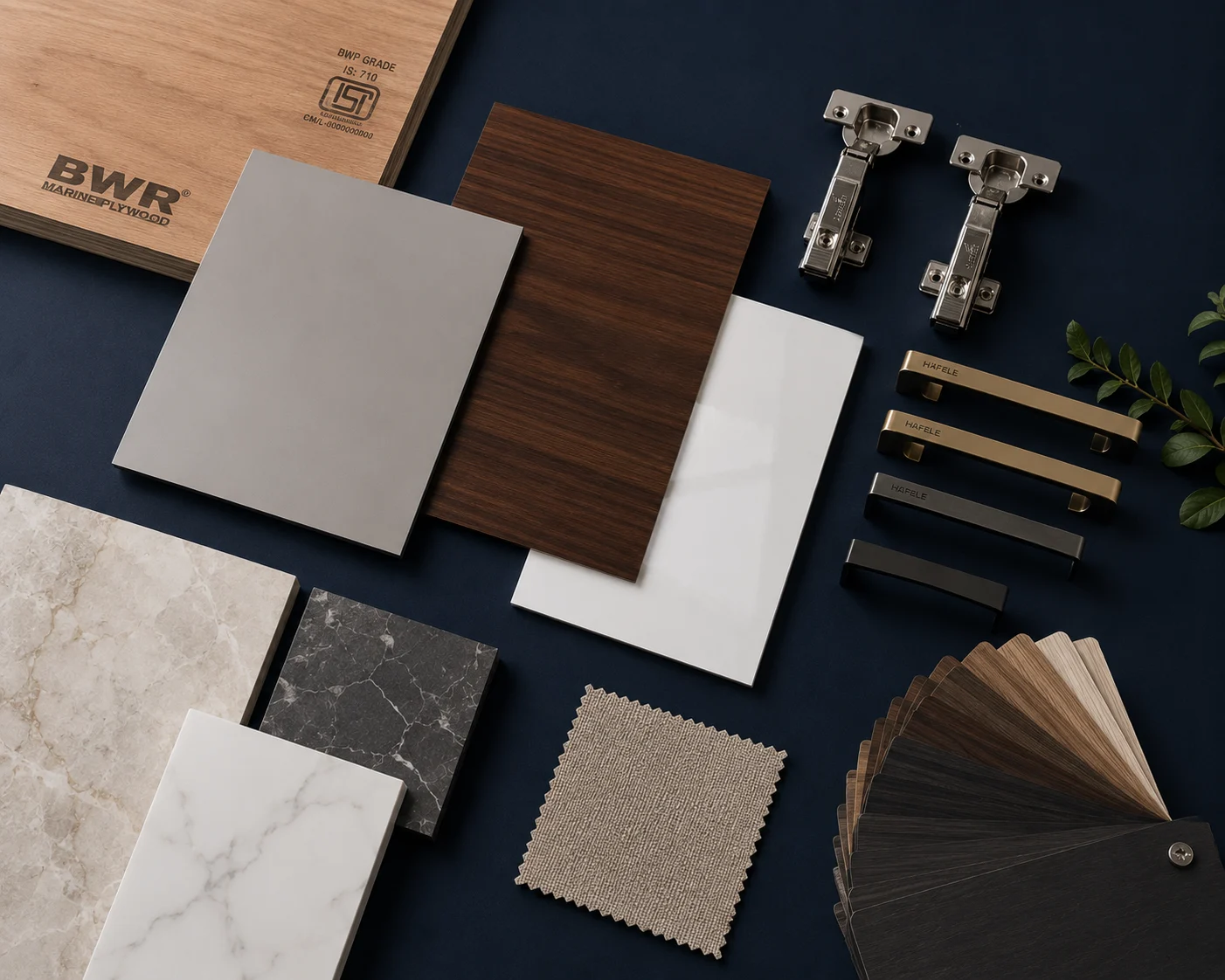
A modular kitchen uses factory-manufactured cabinet units (carcasses) assembled on-site. Each module is precision-cut to 0.1mm using CNC machinery, uses BWR (Boiling Water Resistant) marine plywood or HDHMR board, and accepts standardised premium hardware like Hettich soft-close hinges, Hafele drawer channels, and Blum Tandem Plus systems. The result is a kitchen where every drawer closes at the same weight, every hinge holds at the same tension, and every surface is consistently finished.
What Is a Carpenter-Built Kitchen?
A carpenter-built (civil) kitchen is constructed in-place using commercial-grade plywood, nailed and screwed on-site. Every unit is hand-cut and fitted by the carpenter to the specific space. Quality varies entirely based on the individual carpenter's skill: the best local carpenters in Chennai produce excellent work; the majority produce functional but imprecise work that ages poorly in kitchen conditions.
Cost Comparison in Chennai (2025)
At first glance, modular looks 30% to 50% more expensive per linear foot. But the total cost of ownership over 10 years consistently reverses this. Modular kitchens need far less maintenance: individual modules are replaceable without rebuilding the entire kitchen, hardware is replaceable at Rs.200 to Rs.500 per fitting rather than rebuilding entire cabinets, and they hold value better at resale. A carpenter kitchen that needs full replacement after 8 years costs more in total than a modular kitchen that runs 15 years.
Material Quality: BWR Ply vs Commercial Ply
Chennai's humidity is a kitchen's worst enemy. Modular kitchens from HomeOne use BWR (Boiling Water Resistant) marine plywood that passes IS:710 certification for sustained moisture exposure without delamination. Most carpenter kitchens use commercial-grade plywood (MR grade) that absorbs moisture and swells near sinks and stoves within 3 to 5 years. The difference is not visible on day one; it becomes devastatingly clear after the first Chennai monsoon cycle when cabinet bases begin to lift and doors start sticking.
- BWR Marine Ply (IS:710): resists sustained boiling water exposure, ideal for kitchens
- MR Grade Ply: moisture-resistant but not waterproof, not suitable for kitchen base units
- HDHMR Board: high-density, screw-holding, used for modular carcasses in mid-range kitchens
- Commercial Ply (E2 grade): swells in humidity, should never be used in kitchens
HomeOne uses only BWR marine ply carcasses, Hettich soft-close hinges, and Hafele channel systems on every modular kitchen. All kitchen work is covered under the flat 10-year warranty with no material exclusions.
Hardware Quality: The Element That Makes or Breaks Daily Life
Kitchen hardware is the most-touched element of any home. A household of four touches kitchen hinges, drawer channels, and handle fittings approximately 150 times per day. Cheap unbranded hinges and channels begin to sag and stick within 18 to 24 months. Hettich and Hafele hardware, used in all HomeOne kitchens, is tested to 80,000 opening cycles with no degradation in performance. The cost difference per cabinet is Rs.250 to Rs.600 in hardware, but the performance difference spans the full life of the kitchen.
Hygiene and Ease of Cleaning
Modular kitchens have sealed joints at cabinet corners with PVC edge banding on all exposed edges, soft-close mechanisms that close doors flush, and smooth factory-applied laminate surfaces with no open grain. Carpenter kitchens typically have open joints at internal corners, rough interior surfaces where grease accumulates, and hand-applied laminates with visible grain gaps. In Chennai's kitchen environment, where South Indian cooking produces substantial airborne oil and steam, the hygiene difference between a sealed modular interior and an open carpenter joint compounds over years.
Customisation: Who Actually Wins?
The conventional wisdom that carpenters are more customisable is outdated. Modern modular kitchen systems from Hettich, Hafele, and comparable brands offer over 200 module configurations including corner carousels, pull-out tandem pantry units, internal drawer organisers, under-sink pull-outs, and tall larder units. For genuinely unusual layouts, a highly skilled carpenter can occasionally solve a problem modular cannot. But HomeOne's modular kitchen team handles this for 99% of Chennai apartment kitchens without compromise.
Resale Value Impact in Chennai Property Market
Property buyers in Chennai's competitive resale market consistently pay Rs.2 to Rs.5 lakhs more for a well-maintained branded modular kitchen when evaluating 3BHK apartments. Real estate agents in T. Nagar, Adyar, and Nungambakkam confirm that modular kitchens from recognised brands are now a listing feature, not a nice-to-have. The perception shift reflects genuine quality: a 10-year-old modular kitchen in good condition looks near-new. A 10-year-old carpenter kitchen typically shows significant wear.
The Verdict: When to Choose Each
- Choose modular: for 95% of Chennai apartments, any budget above Rs.1.2 lakhs, when quality and resale value matter
- Choose carpenter: only for genuinely non-standard layouts that modular cannot accommodate, or for budgets under Rs.90,000 per linear foot
- Choose modular with warranty: always, if post-completion service matters to you